
How run-flat tyres work
A run-flat tyre has reinforced sidewalls that keep supporting the weight of the car after it loses pressure. Goodyear explains that this lets you continue at reduced speed to a safe place, without having to change a wheel at the roadside.
Run-flats do not make a puncture any less likely, as Goodyear also points out. Their job is to keep you moving safely after one.
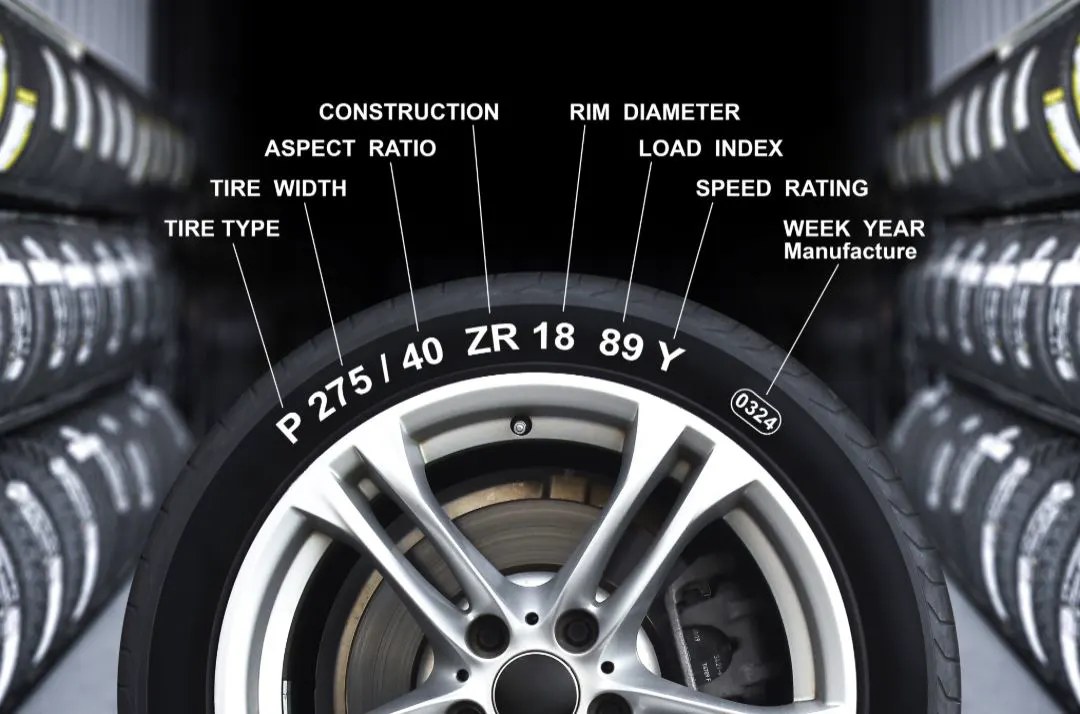
Cars fitted with run-flats usually have no spare wheel, so it helps to know what is on yours. Pirelli lists sidewall markings that identify run-flats, though markings vary between makers, so check the handbook if you are unsure.
| Marking | What it means |
|---|---|
| RSC in a circle | ISO symbol for a run-flat system component |
| RFT | Run Flat Technology |
| SSR | Self Supporting Run Flat |
| ROF | Run On Flat |
| ZP or EMT | Michelin's Zero Pressure and Extended Mobility Tyre markings |
| Run Flat | Written on the sidewall of Pirelli run-flat tyres |
How far and how fast can you drive on a punctured run-flat?
The figure most drivers hear is about 50 miles at up to 50mph. The RAC says many run-flats allow limited driving after pressure loss, commonly up to 50 miles at no more than 50mph, but that the precise limit varies. Pirelli gives a similar figure of around 50 miles at up to 50mph.
Treat that as a ceiling rather than a target. Michelin quotes up to 80km at up to 80km/h for its run-flats, and says the real range depends on the load in the car, the outside temperature and the road. TyreSafe adds that run-flats are only designed to run for a limited period at up to 50mph, with a limited load-carrying capacity.
The limit for your car is in the vehicle handbook, so check it rather than relying on a general rule. Pirelli warns that run-flats are not designed to be driven on long term and will deteriorate, so head straight for home, work or a tyre fitter.
- Slow down smoothly to within the limit in your handbook, often 50mph at most
- Expect the car to feel bumpier and stiffer than usual, and drive gently
- Count the distance from when the warning came on, and use as little of it as you can
- Head for the nearest sensible destination, such as home, work or a tyre fitter
- Stop and call for help if the tyre looks badly damaged or the car feels unsafe
Why run-flats need a tyre pressure warning system
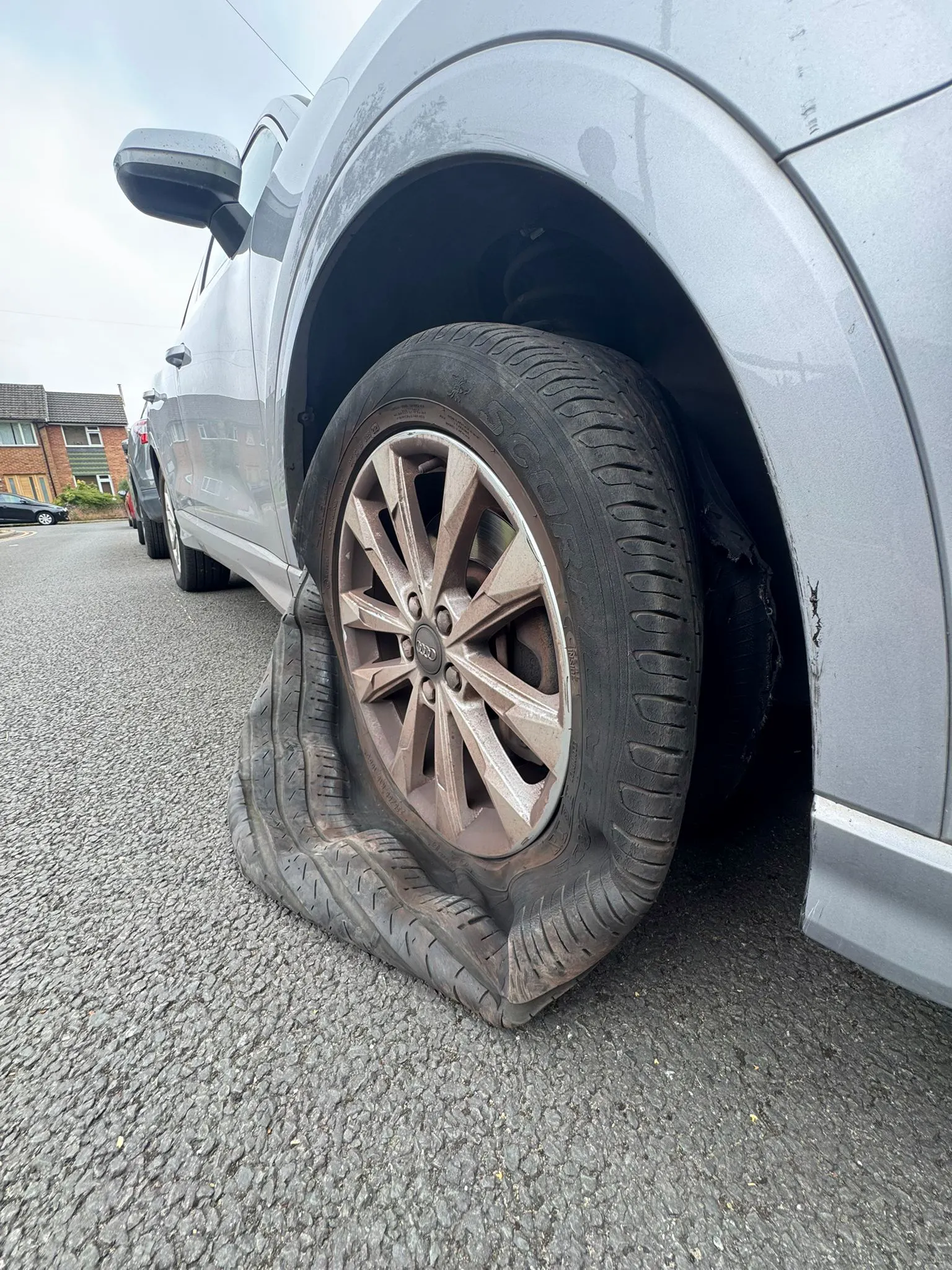
Because the sidewalls hold the car up, a punctured run-flat may not look or feel obviously flat. Pirelli notes that the warning system is especially useful for slow punctures, which may not be immediately obvious when driving.
That is why the warning light matters so much. TyreSafe says run-flat tyres should only be fitted to vehicles with a tyre pressure monitoring system (TPMS), and Michelin and Goodyear say the same of their own run-flats.
Keep the system working and do not rely on it alone. If the light stays on after the pressures are corrected, have it checked, as there may be a sensor fault. On cars first used on or after 1 January 2012, a TPMS that is malfunctioning or obviously not working is a major MOT defect, and TyreSafe recommends regular manual pressure checks as well.
Can a run-flat tyre be repaired?
It depends on the tyre maker, and their rules differ. Michelin's guidance says each manufacturer decides whether its run-flats can be repaired, and the table below shows how three makers approach it.
Where a repair is allowed, the normal limits still apply. Goodyear does not support repairs outside the tread area, damage to the sidewall or inner liner, or any damage that would make a standard tyre unrepairable, and Michelin applies the same conditions and inspection procedure as for its standard tyres.
How far the tyre was driven while deflated matters too. The RAC notes that run-flats cannot be repaired as easily as regular tyres and must be removed and inspected for further damage, so after a run-flat puncture, drive on the tyre as little as possible if you hope to save it.
| Tyre maker | What its UK guidance says |
|---|---|
| Michelin (ZP, EMT) | Can be repaired only once, by a professional, using the same inspection and repair procedure as a standard tyre, unless the sidewall says it cannot be repaired |
| Goodyear (Run On Flat) | Can be repaired by a qualified tyre professional after a thorough inspection and a check of the tyre's history. Only one repair in the tyre's lifetime, and not after a substantial distance at low or zero pressure |
| Pirelli (Run Flat) | Should be replaced rather than repaired, because secondary damage cannot be identified |
Replacing a run-flat tyre
If the tyre cannot be repaired, replace it with another run-flat. Pirelli says run-flats should always be replaced like for like, because a standard tyre will reduce traction and control, and Michelin recommends a full set of four run-flats.
Mixing types is best avoided. The DVSA's MOT inspection manual says run-flat and conventional tyres can be mixed on the same axle, although this is not recommended. Switching to conventional tyres would also leave a car that usually has no spare wheel with no way to drive on after a puncture.
Avoid part-worn run-flats too. Goodyear strongly recommends against them, because the tyre's history of damage and repairs is unknown, which makes it hard to predict how it will behave after a puncture.
If you have a punctured run-flat, you can call us on 07356 062568 24/7. Give us the tyre size, brand and sidewall markings, and we will talk you through the options before we set off. Every call-out includes a tyre inspection to decide whether a safe repair is possible or a replacement is needed.
Related services
If you would rather not drive on a deflated run-flat, our emergency tyre assistance can come to you 24 hours a day.
Whether a run-flat can go through our mobile tyre repair service depends on the maker's rules, so tell us the brand when you call.
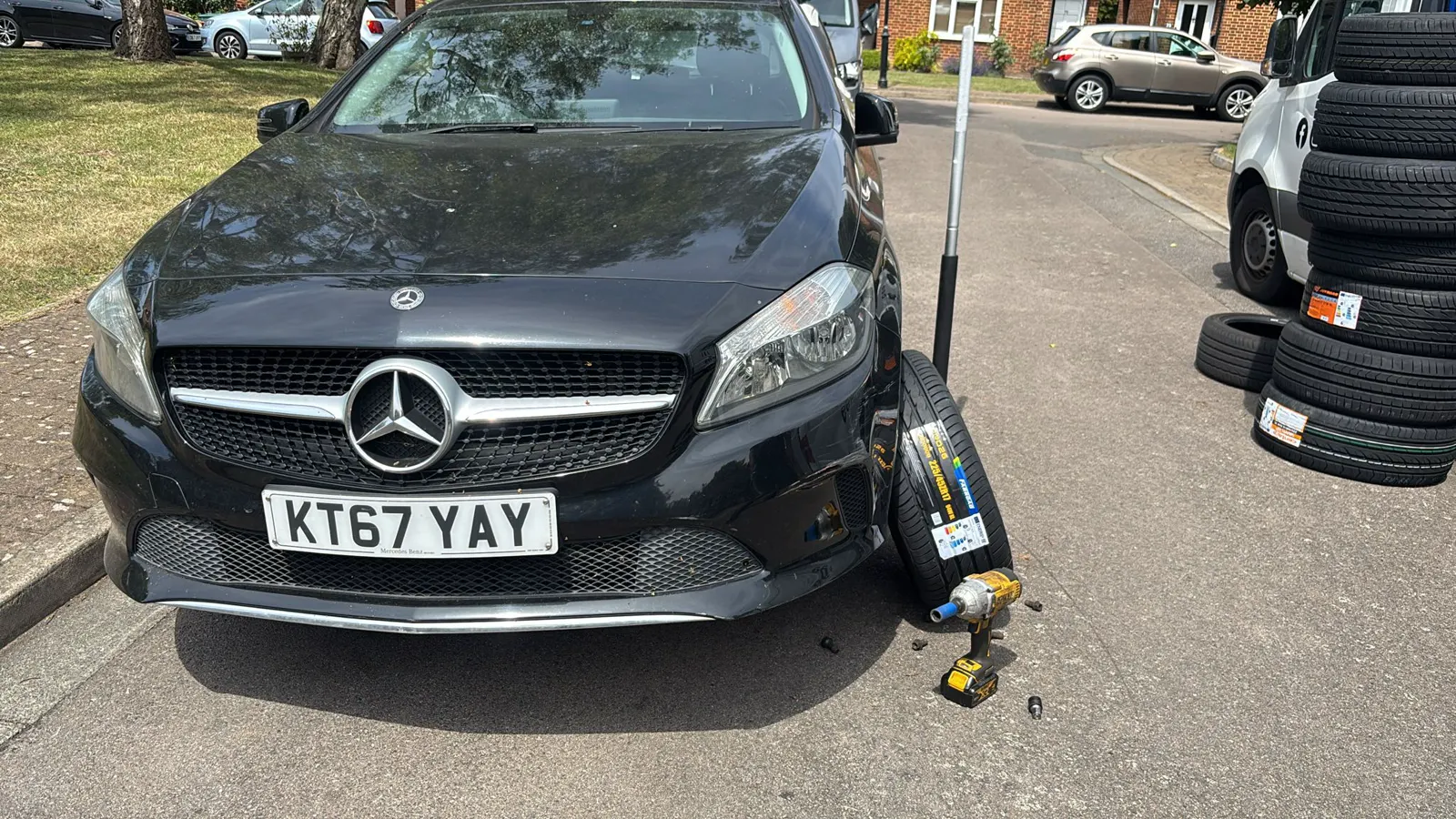
For a replacement, give our mobile tyre fitting team the full tyre size and run-flat marking and we will confirm what we can supply.
How do I know if my car has run-flat tyres?
Check the sidewall for markings such as the RSC symbol in a circle, RFT, SSR, ROF, ZP, EMT or the words Run Flat. Markings vary between makers, so the handbook is the surest guide. A missing spare wheel can be a clue, but check the tyres to be sure.
Can I really drive 50 miles on a punctured run-flat?
Often, but not always. Many run-flats are rated for about 50 miles at up to 50mph after losing pressure, but the limit varies with the tyre and the car, and Michelin says range also depends on the load, outside temperature and road. Check your handbook and drive only as far as you need to.
Do run-flat tyres need a TPMS?
Yes. TyreSafe says run-flats should only be fitted to vehicles with a tyre pressure monitoring system, and makers including Michelin and Goodyear say the same. Without one, you might not notice a deflated run-flat until it had been driven too far.
Can I replace run-flats with normal tyres?
It is not recommended. Pirelli advises replacing run-flats like for like, and the MOT inspection manual says mixing run-flat and conventional tyres on the same axle is not recommended. You would also lose the ability to drive on after a puncture, usually on a car with no spare wheel.
Can a run-flat tyre be repaired after a puncture?
Sometimes. It depends on the maker: Michelin allows one repair by a professional, Goodyear allows a repair after a thorough inspection, and Pirelli says its run-flats should be replaced. How far the tyre was driven while deflated also matters. Call us with your tyre size and brand and we'll confirm.
Why does my run-flat tyre not look flat?
Its reinforced sidewalls keep supporting the car after the air has gone, so a punctured run-flat may look almost normal. That is why run-flats rely on a tyre pressure warning system. If the light comes on, check the pressures with a gauge as soon as you can stop safely.