
Mobile TyreFitting Today
Open 24/7 07356 062568
Can a Punctured Tyre Be Repaired?
  1. Home
  2. Tyre Advice
  3. Can a Punctured Tyre Be Repaired?

Open now · 24 hours, 7 days

Can a Punctured Tyre Be Repaired?

Practical advice from 24/7 mobile tyre fitters in Surrey and South London.

  • RAC Accredited Repairer
  • 30 minTypical response
  • 24/7Every day of the year
  • 10,000+Tyres in stock
  • 5+ yrsOn the road

Quick answer: Often, yes. In the UK a punctured car tyre can usually be repaired if the damage is a small hole in the central part of the tread and the tyre has no other damage. Punctures in the sidewall or shoulder, large holes, or tyres driven on while flat normally need replacing.

The short answer

Many punctures are repairable. A nail or screw in the middle of the tread is the classic repairable puncture, provided the hole is small and the tyre has not been damaged by being driven on flat.

Whether a punctured tyre can be repaired depends on three things: where the damage is, how big it is, and the condition of the rest of the tyre. A proper inspection is the only way to know for sure, and that means looking inside the tyre as well as outside.

It also helps to know what not to do. If a nail or screw is still in the tyre and the tyre is holding some air, leave it where it is. Pulling it out usually makes the leak much faster, and leaving it in shows the fitter exactly where the damage is.
The British Standard for tyre repairs: BS AU 159

Car tyre repairs in the UK are governed by British Standard BS AU 159. It sets out where a repair can be made, the limits on the size of the damage, and how the repair must be carried out.

One of its key requirements is that the tyre must be removed from the wheel so it can be inspected inside. Damage that looks minor from the outside can hide problems on the inner liner, such as rubbing or tearing from being driven while under-inflated.

A plug pushed in from the outside without removing the tyre is not a repair that meets the standard. If you have had a quick external plug fitted in the past, it is worth having that tyre inspected properly.

The repairable zone: where a puncture can be fixed

BS AU 159 only allows repairs within the central repairable area of the tread, which is roughly the central three-quarters of the tread width. The outer edges, called the shoulders, and the sidewalls are outside that zone.

The reason is how a tyre flexes. The shoulder and sidewall bend constantly as the wheel turns, and a repair in that area cannot be relied on to hold. So even a very small hole near the edge of the tread usually means a new tyre.

If the tyre already has a repair, a second one may or may not be possible depending on where the first repair sits and how close the new damage is. The inspection will decide, and we will explain the reason either way.

  • Central tread: usually repairable, subject to size limits and inspection
  • Shoulder (outer edge of the tread): not repairable under BS AU 159
  • Sidewall: not repairable, the tyre needs replacing
  • Bulges, cuts or exposed cords anywhere: replace the tyre

When a tyre cannot be repaired

Some damage rules out a repair straight away. A cut or gash in the sidewall, a bulge, or cords showing through the rubber all mean the tyre's structure is compromised.

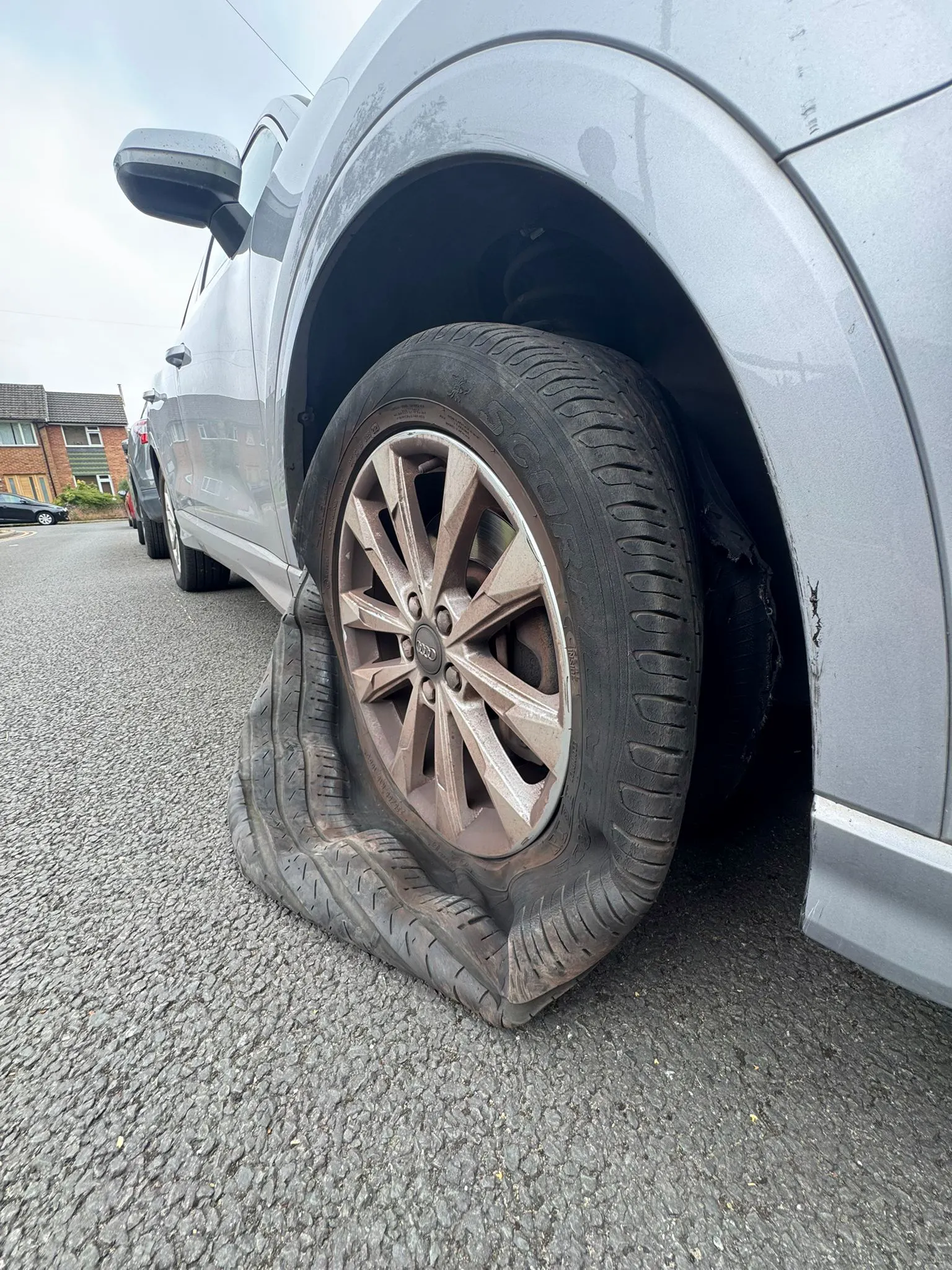
Driving on a flat tyre is the other common reason a repair is refused. Even a short distance on a deflated tyre can crush the sidewall against the rim and damage the inside of the tyre. If you notice a flat, stop as soon as it is safe and do not keep driving to reach a garage.

A tyre that is already close to the legal tread limit is also a poor candidate. Repairing a tyre you will need to replace soon rarely makes sense, and we will tell you honestly if that is the case.

  • Damage in the sidewall or shoulder
  • A hole larger than the standard allows for that tyre
  • Signs of being driven on while flat, such as internal rubbing or a crease in the sidewall
  • Bulges, splits, exposed cords or an existing repair too close to the new damage
  • Tread worn close to or below the legal limit

Slow punctures and tyre sealant

A slow puncture is a tyre that keeps losing pressure over hours or days. Common causes are a small nail or screw, a damaged valve, or a poor seal between the tyre and the wheel rim, which can happen with corroded alloys.

Slow punctures are worth sorting quickly. Running on low pressure increases wear, affects handling and braking, and can damage the tyre to the point where it can no longer be repaired.

Signs of a slow puncture include a tyre that looks lower than the others, a tyre pressure warning light that keeps coming back after you top up, or a car that feels like it is pulling slightly to one side. Checking pressures once a month and before long journeys makes it easier to catch early.

Many new cars come with a sealant and compressor kit instead of a spare. Sealant is a temporary get-you-home measure, so follow the kit's speed and distance limits and let your fitter know it has been used, because the sealant has to be cleaned out before the tyre can be inspected.

Can a run‑flat tyre be repaired?

Run-flat tyres are built to keep going for a limited distance after losing pressure. Whether one can be repaired after a puncture depends on the tyre manufacturer's guidance, and some manufacturers do not approve repairs at all.

How far and how fast the car was driven while deflated also matters. If you have a run-flat with a puncture, call us with your tyre size and brand and we will talk you through the options before we come out.

What happens when we check your punctured tyre

Every call-out includes a tyre inspection to decide whether a safe repair is possible or a replacement is needed. We look at the location and size of the damage, remove the tyre from the wheel to check inside, and look at the tread depth and overall condition.

If the tyre can be repaired safely, we repair it. If it cannot, we explain why and fit a replacement from the stock in the van. You decide before any work goes ahead.

If you are not sure whether your tyre can be repaired, you can send a photo of the damage on WhatsApp so we can tell you what to expect before we arrive. The final decision is always made once the tyre is off the wheel and checked inside.

How Mobile Tyre Fitting Today can help

If you have a puncture, a slow leak or a flat tyre, call us on 07356 062568. We answer 24/7 and come to your home, workplace or roadside across Surrey, south and south-west London and West Sussex.

We are an RAC Accredited Repairer with more than 10,000 tyres in stock, so if a repair is not possible we can usually fit a replacement on the same visit. We reach most locations within 30 minutes, and our pricing is fair and transparent with no hidden fees.

Questions drivers ask

Still unsure? Call 07356 062568 any time, day or night.

07356 062568

Can a nail in a tyre be repaired?

Often, yes. If the nail is in the central part of the tread, the hole is within the size limits of BS AU 159 and the tyre has not been driven on flat, it can usually be repaired. The tyre needs to come off the wheel for an inside inspection first. Leave the nail in place until then if the tyre is holding air.

Can a puncture in the sidewall be repaired?

No. Sidewall and shoulder damage cannot be repaired under the British Standard BS AU 159, because those areas flex constantly as the wheel turns and a repair would not hold reliably. A tyre with sidewall damage, a bulge or a cut in the sidewall needs to be replaced.

Is it safe to drive on a slow puncture?

It is best avoided. Low pressure affects braking and handling and can damage the tyre internally, which may make a repair impossible. If you must move the car a short distance, check and inflate the tyre first and drive gently. The safest option is to have it inspected where the car is parked.

How long does a tyre puncture repair last?

A repair carried out properly to BS AU 159, with the tyre removed and inspected inside, is designed to be permanent for the remaining life of the tyre. A plug fitted from the outside without removing the tyre does not meet that standard and should be treated as temporary.

Can you repair a tyre that has had sealant in it?

Sometimes. The sealant has to be cleaned out before the tyre can be inspected, and the decision then depends on the damage like any other puncture. Tell us the sealant has been used when you call, and avoid driving further than the kit's instructions allow.

Need a tyre fitted now?

07356 062568

Our mobile tyre fitters come to your home, workplace or roadside across Surrey, South London and West Sussex, 24 hours a day.

Call nowWhatsApp