
What the tyre pressure warning light means
The tyre pressure warning light is usually an amber horseshoe-shaped symbol, a tyre seen in cross-section, with an exclamation mark in the middle. It belongs to the tyre pressure monitoring system, or TPMS, which watches your tyre pressures as you drive.
The light normally comes on briefly when you switch on the ignition and then goes out. If it stays on, the system has detected a loss of pressure in one or more tyres. On many cars, a light that flashes for a while and then stays on means the system itself has a fault.
TPMS became compulsory on new passenger cars sold in the EU, which then included the UK, from November 2014. It is a useful safety net, but TyreSafe is clear that it does not replace regular manual pressure checks.
Direct vs indirect TPMS
There are two main types of system, and your handbook will tell you which one your car has. If the dashboard can show a pressure reading for each tyre, the car almost certainly has direct TPMS.
A direct system has a sensor in each wheel, usually on the valve, that reports the actual pressure. An indirect system uses the ABS wheel speed sensors instead, because a tyre that loses pressure gets slightly smaller and spins faster than the others.
Direct sensors run on sealed batteries that eventually run down, which can trigger a warning on an older car. TyreSafe advises against swapping a TPMS valve for a standard valve to get rid of a warning.
| Feature | Direct TPMS | Indirect TPMS |
|---|---|---|
| How it works | A sensor in each wheel, usually on the valve, measures the pressure | ABS wheel speed sensors compare how fast each wheel turns |
| After adding air | The light often clears by itself once you drive | Usually needs a reset with a button or menu |
| After new tyres or rotation | Sensors need care when tyres are changed, and some cars must relearn their positions | Reset with all tyres at the correct pressure |
| Common non-tyre cause of a warning | A sensor with a flat battery or damage | The system not being reset after the pressures were changed |
What to do when the light comes on
If the light comes on while you are driving and the car feels normal, plan to stop somewhere safe, such as a car park or fuel station. If the steering feels heavy, the car pulls or you hear thumping or flapping, slow down gently and stop as soon as it is safe. On a motorway, follow our guide to a flat tyre on the motorway.
The Highway Code advises checking pressures weekly, before a journey, when the tyres are cold, as warm tyres can give a misleading reading. The correct figures are in your handbook and often on a sticker in the driver's door jamb or fuel filler flap.
- Look at all four tyres for anything flat or damaged
- Check each pressure with a gauge and inflate to the handbook figure for the load
- Look for a nail, screw or cut in the tread and sidewalls
- Reset the system if your car needs it, then see whether the light stays off
How to reset the tyre pressure warning light
The reset method depends on the car, so start with the handbook. Pirelli notes that reset buttons are commonly found under the steering wheel or on the dashboard, while on many cars the reset is in the on-board computer menu.
Set every tyre to the correct pressure before you reset. An indirect system takes the state of the tyres at the moment of the reset as its reference, so resetting with a low tyre teaches it the wrong starting point.
After a reset, the car usually needs a short drive to recalibrate, and Pirelli says that on some cars, driving for about 10 minutes and then switching off and on again can clear the light. On some cars, a replacement sensor also has to be programmed with a diagnostic tool. If the light will not clear, or comes straight back, have the tyres and the system checked.
Why cold weather sets off the light
Air contracts as it cools, so tyre pressures fall when the temperature drops. Continental says pressure drops by about 0.07 to 0.14 bar, or 1 to 2 psi, for every 10°C fall in temperature.
That is why the light often appears on the first cold mornings of autumn, then goes out once the tyres warm up on a drive. Continental notes the warning comes on more often in winter, particularly on cold mornings.
The light going out does not mean the tyres are right. Top them up to the handbook pressure while they are cold, and check them at least every two weeks in winter, as Continental advises.
When the warning light means a puncture
If the light comes back within hours or a day or two of inflating the tyres, or one tyre is always lower than the others, a slow puncture is a common cause. A leaking valve or a poor seal between the tyre and the wheel rim can have the same effect.
Look closely at the tread for a nail or screw, and if the tyre is still holding air, leave it in place. Our guide to punctured tyres explains when a repair is safe.
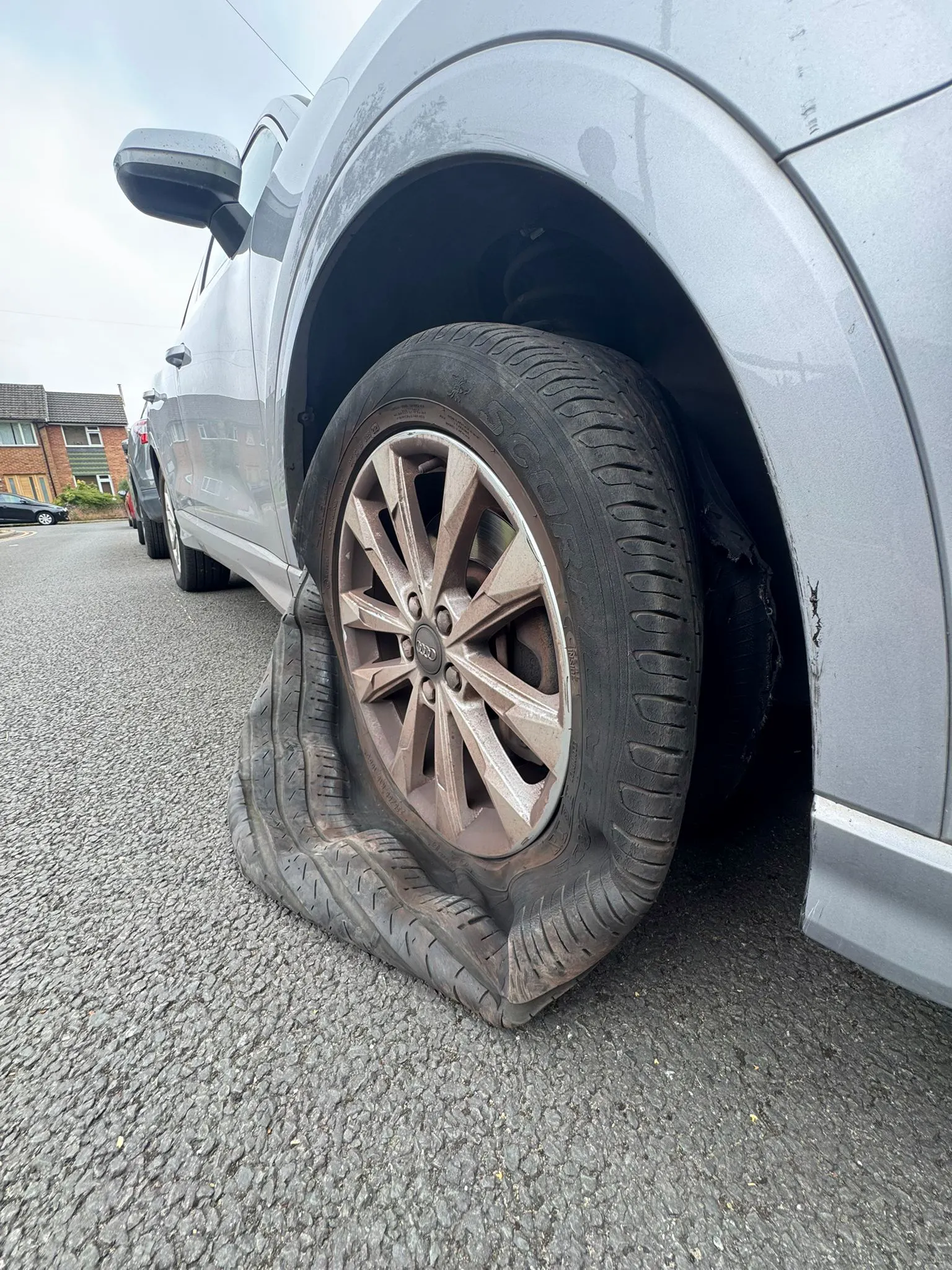
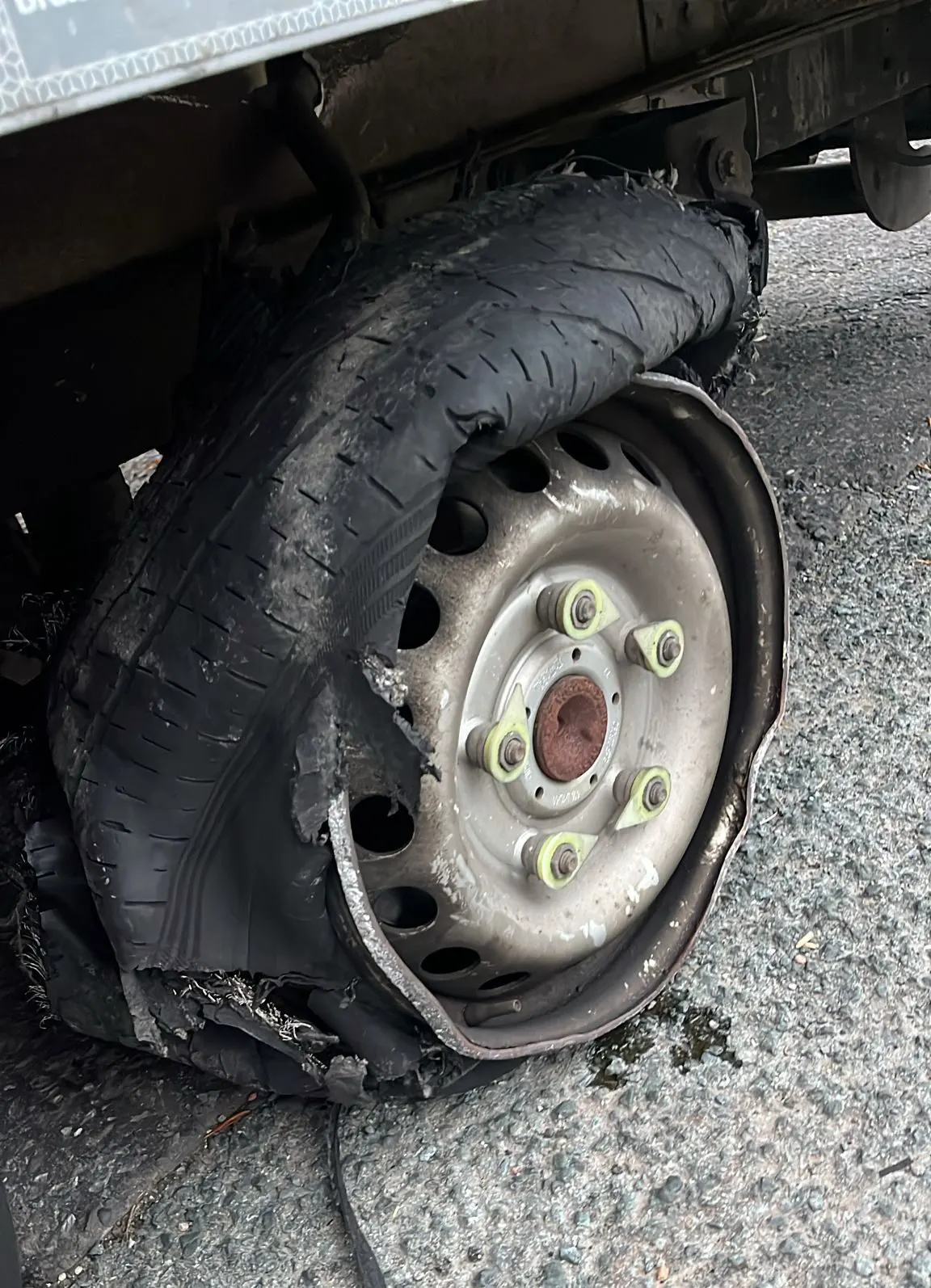
If a tyre is visibly flat, do not drive on it. Even a short distance on a flat tyre can damage it beyond repair.
Every call-out we attend includes a tyre inspection to decide whether a safe repair is possible or a replacement is needed. You can reach us 24/7 on 07356 062568.
TPMS and the MOT
TPMS checks became part of the MOT in January 2015. Under the MOT inspection manual, the system is checked on M1 vehicles, meaning passenger cars with up to 8 passenger seats, first used on or after 1 January 2012. Motor caravans, ambulances and hearses approved as M1 with a gross vehicle weight over 2,500kg are excluded.
On those cars, a TPMS that is malfunctioning or obviously not working is a major defect, so the car fails. A lamp that is lit because a tyre has lost pressure is not automatically a fault. The manual notes that a malfunction may show as the lamp flashing a number of times and then staying on, and that the tester should record an advisory if it is unclear which it is.
An obviously under-inflated tyre is a minor defect, which does not cause a fail on its own. Before the test, set the pressures, make sure the light goes out and get any system fault looked at.
Related services
If the light keeps returning because of a slow puncture, our mobile tyre repair service can check whether the tyre can be fixed safely.
If the warning comes on and a tyre goes flat, our emergency tyre assistance runs 24 hours a day.
When a tyre cannot be repaired, we offer mobile tyre fitting at your home, workplace or a safe roadside spot.
Can I drive with the tyre pressure warning light on?
Only as far as a safe place to check the tyres. The light means a tyre may be low, and the Highway Code says tyres must be correctly inflated. If a tyre is flat or the car is handling oddly, do not carry on driving.
Why is my tyre pressure light on when the tyres look fine?
A tyre can be noticeably low before it looks flat, so the only reliable check is a gauge. Other common reasons are a drop in temperature overnight, a system that needs resetting after the pressures were changed, or a fault with a sensor or the system itself.
How do I reset the tyre pressure warning light?
Set all four tyres to the pressure in your handbook first. Then use the TPMS button or the menu on the dashboard display and drive for a short while so the system can recalibrate. Many direct systems clear the light by themselves once the pressures are correct.
Will a tyre pressure warning light fail the MOT?
A faulty system will. On passenger cars first used on or after 1 January 2012, a TPMS that is malfunctioning or obviously not working is a major defect. A light that is on simply because a tyre is low is not automatically a fault, but the tester may record an advisory, so correct the pressures before the test.
What does a flashing tyre pressure warning light mean?
On many cars, a light that flashes when you start the car and then stays on means a system fault, such as a failed sensor, rather than a low tyre. Check the pressures anyway, then have the system looked at, as it may not warn you of a real pressure loss until it is fixed.
Should I put extra air in my tyres in winter?
Not unless your handbook says so. Inflate to the pressure your car's manufacturer recommends, checked when the tyres are cold, and check more often in cold weather because pressure falls as the temperature drops.